Wojciech Bos · Senior Full-Stack & AI EngineerBased in Warsaw, Poland. Moving to Brescia, Italy in 2027. Open to freelance work.
I take on the problems others back away from, then see them through to production.
I build whole systems, not one layer of a stack: from C++ runtimes to the dashboards on top of them.
Currently at Sii Poland, the only engineer on ECCO’s Shipment Intelligence platform. Most days that means NestJS services and React frontends in TypeScript, AI agents wired to live logistics data through MCP and RAGFlow, and scikit-learn models that explain the numbers. All of it ships to Kubernetes.

About
Right now I’m building a supply-chain risk platform for ECCO as its only engineer. Before that, I moved a mission-critical rule engine off Palantir Foundry onto a cloud-native Python platform with 100% data parity. Earlier still, I turned a stalled forecasting module into a production service in two months.
I wrote my first line of C++ in 2015 and started professionally at Samsung R&D in 2019. Since then I’ve worked on Smart TV streaming apps, smart-home IoT drivers and time-series forecasting, in Python, TypeScript, JavaScript, Lua and C++. The domain keeps changing, the habit stays the same: I ship the whole thing.
Working across that many domains and languages is deliberate. It lets me connect technologies that rarely meet. My F1 telemetry pipeline, a side project, goes from a C++26 edge agent through FlatBuffers and ZeroMQ to a NestJS hub and a React dashboard redrawing at 60 Hz: one system, from UDP packet to pixel. It also shows me problems and shortcuts that someone who lives in one stack won’t see, and it has made learning routine: I understand a new tool quickly and start implementing right away. Point me at a problem in something I’ve never touched, and I’ll close the gap fast and deliver more than was asked.
- Systems that are boring in production and fun to build.
- Fewer moving parts, fewer 3am pages.
- Getting from “this is a weird idea” to “this works” fast.
- Done means in production, not merged.
- English
- Near-native, my everyday language
- Italian
- Fluent
- Polish
- Native
Experience
Sii Poland
Apr 2026 – Present
Senior Full-Stack & AI Engineer · ECCO
Sole engineer behind a Shipment Intelligence platform that tracks manufacturing supply chains and scores disruption risk in real time.
Show 7 highlightsHide highlights
- Designed and delivered the whole platform alone, from data ingestion to the real-time shipment map ([METRIC?] shipments tracked) and executive dashboards.
- As the only engineer, owned every architecture decision and worked directly with business stakeholders on what to build next.
- Connected Model Context Protocol (MCP) servers to third-party logistics APIs, with real-time sync and two-way write-backs.
- Built multi-agent RAGFlow workflows that cross-check news and geopolitical events against live shipment routes to score risk automatically. Playwright scrapers, RSS feeds and n8n cron jobs feed them.
- Added an analytical agent backed by scikit-learn and Pandas that turns route statistics and ML metrics into plain answers for non-technical stakeholders.
- Wrote a rule-based normalisation engine with a route-enrichment service that copes with anomalous data and fills transit blind spots.
- Moved run history into PostgreSQL JSONB audit logs, so long-running containers don’t keep growing in memory.
Nov 2025 – Mar 2026
Senior Python Developer · K2 Integrity
Brought in to take a mission-critical rule-execution engine to MVP. Migrated it from Palantir Foundry to a cloud-native Python platform, launched it to production with 100% data parity, then moved on to the next client.
Show 7 highlightsHide highlights
- Designed a resilient dual-service system (Pooler & Worker) coordinated through a PostgreSQL-backed state machine.
- Owned delivery from MVP through to the production launch.
- Converted PySpark business logic ([METRIC?] execution rules) from Palantir Foundry to optimised, maintainable Pandas and NumPy.
- Built a testing framework that proved 100% computational parity between the legacy and new systems for audit and compliance.
- Built a FastAPI backend with a four-eyes approval workflow for uploading, managing and auditing execution rules.
- Replaced legacy Redis/Celery workflows with a PostgreSQL-based queue, gaining reliability with less infrastructure.
- Deployed the whole ecosystem to Azure Kubernetes Service, with DAPR for scheduling.
Krypton Polska
Jul 2025 – Nov 2025
ML Engineer / Backend Developer
Owned a time-series forecasting microservice end to end and turned a stalled module into a production-ready service in two months.
Show 4 highlightsHide highlights
- Took full ownership of the forecasting module, built on FastAPI and containerised with Docker.
- Forecast any time-series feature from InfluxDB by calculating feature importance and applying XGBoost models. Also researched LSTM alternatives.
- Refined model performance ([METRIC?] accuracy gain) and validated feature configurations through analysis in NumPy, Pandas and scikit-learn.
- Deployed to Kubernetes, integrated into the CI/CD pipeline and covered with Pytest.
Samsung R&D Institute Poland
Feb 2025 – Jun 2025
Software Engineer
Built Lua EdgeDrivers that bring Zigbee, Z-Wave and Matter devices into SmartThings, the last mile between physical hardware and cloud automation. Certified in Jung Basic KNX (Jung Polska, 2025).
Show 3 highlightsHide highlights
- Implemented device-specific functionality in EdgeDrivers for Zigbee, Z-Wave and Matter devices.
- Supported debugging, certification, internal testing and system automation.
- Helped run technical workshops for external developers.
Apr 2024 – Feb 2025
SmartThings Operations Engineer
Built the internal tools that automated SmartThings IoT device certification ([METRIC?] time saved per device), from Django APIs to React frontends.
Show 4 highlightsHide highlights
- Built backend services and REST APIs in Django and Django REST Framework on PostgreSQL.
- Built data pipelines with Pandas, OpenPyXL and Beautiful Soup, plus tools that turn JSON test results into readable reports.
- Built internal frontends in React, Redux and Sass.
- Tested Zigbee, Z-Wave and Matter devices with strategic partners and QA teams to smooth onboarding.
Dec 2019 – Apr 2024
Smart TV Application Support Engineer
Started as an intern and earned a full-time role within three months by rescuing, with one other junior, a project that had lost its lead. From then on the work was far more engineering than the title suggests.
Show 8 highlightsHide highlights
- Still a junior, rescued a project that had lost its lead, together with one other junior engineer.
- Interviewed candidates and evaluated technical assignments.
- Ran workshops, technical training and onboarding for external developers and QA engineers.
- Built Python tools for debugging, log analysis and automation, plus automated test scripts for OTT and media apps.
- Resolved platform-level issues across multiple TV generations and supported internal launches of new TV models.
- Onboarded and supported [METRIC?] global partners building high-traffic streaming apps with JavaScript, Tizen API, Shaka Player and Firebase.
- Analysed operational data with Pandas and Matplotlib.
- Managed test environments, including TV hardware and firmware updates.
Systems & products I’m building
My own work, outside client projects.
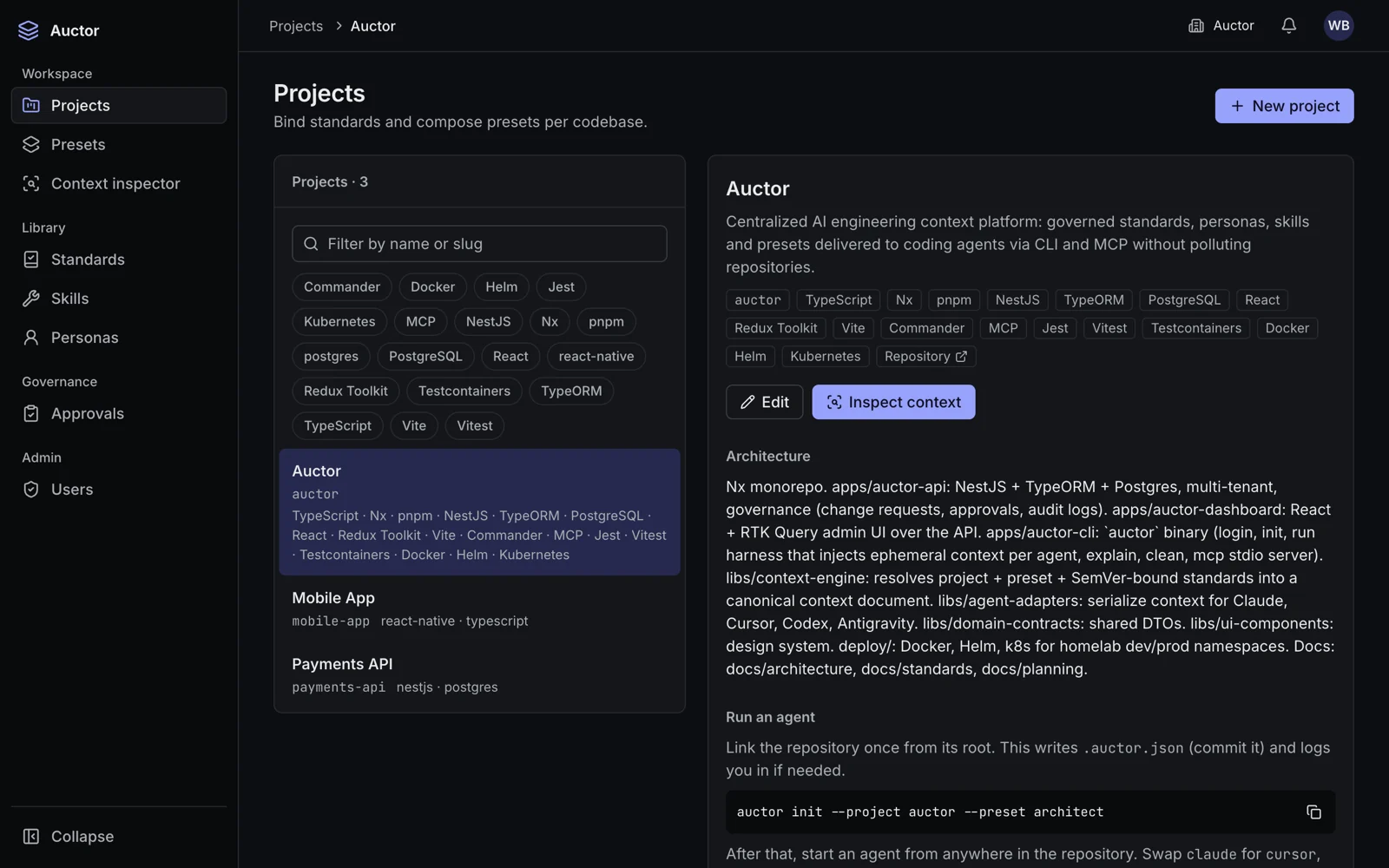
Close to launch, as a product for companies
Auctor
A self-hosted platform that gives every AI coding agent the same engineering standards, with no agent config files in your repositories.
Standards, skills, personas and presets are versioned and governed in one place. The CLI resolves them per project and injects them into Claude Code, Cursor, Codex or Antigravity at launch. An MCP server does the same for desktop apps.
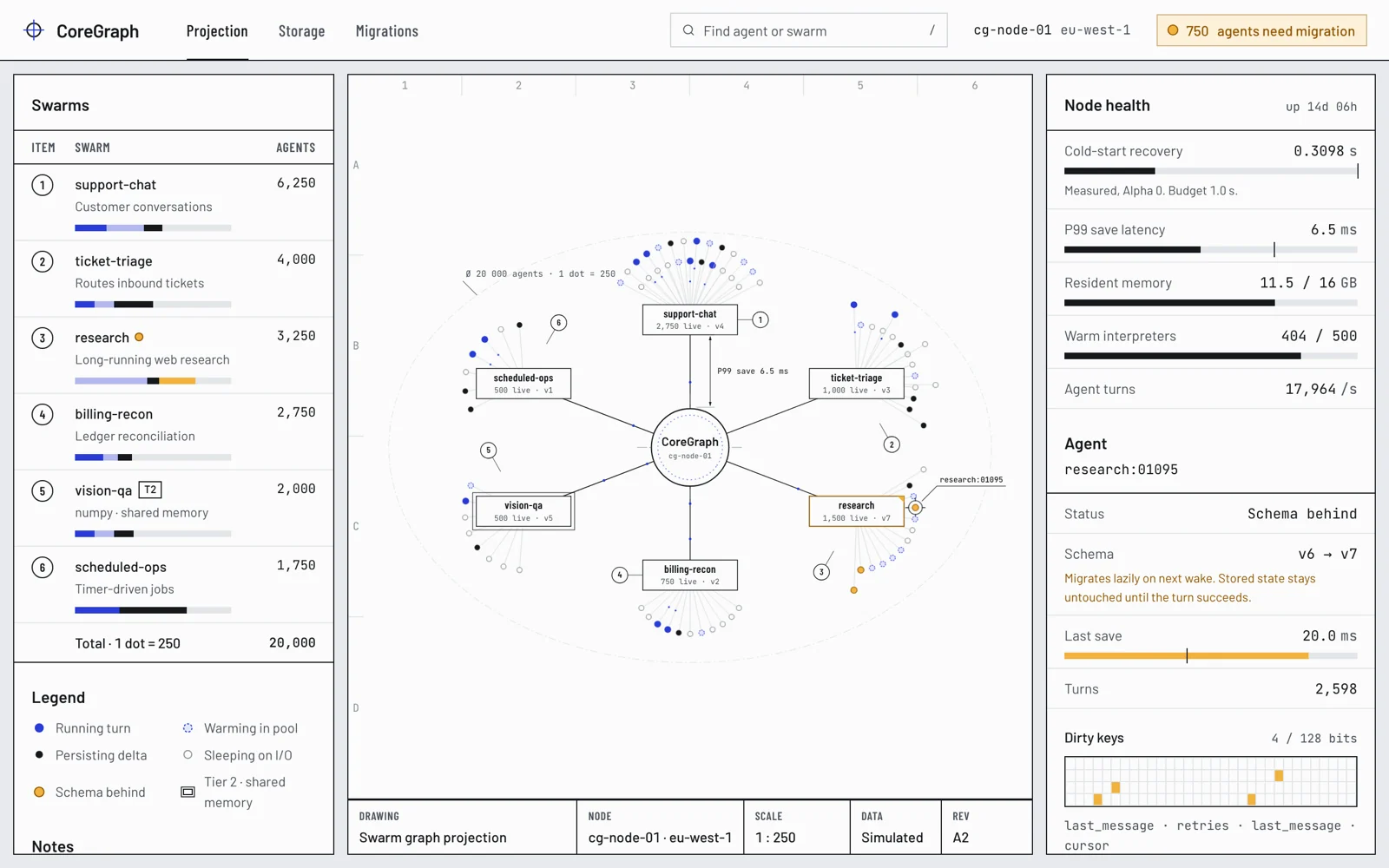
Research stage, proving it can be done
CoreGraph
A C++ runtime for running thousands of stateful AI agents on a single machine.
Agents sleep on I/O and wake into pre-warmed Python sub-interpreters, and only the state they changed is written to RocksDB. The target is 20,000 agents in 16 GB of RAM. An early prototype recovered all 20,000 states from a cold start in 0.31 s.
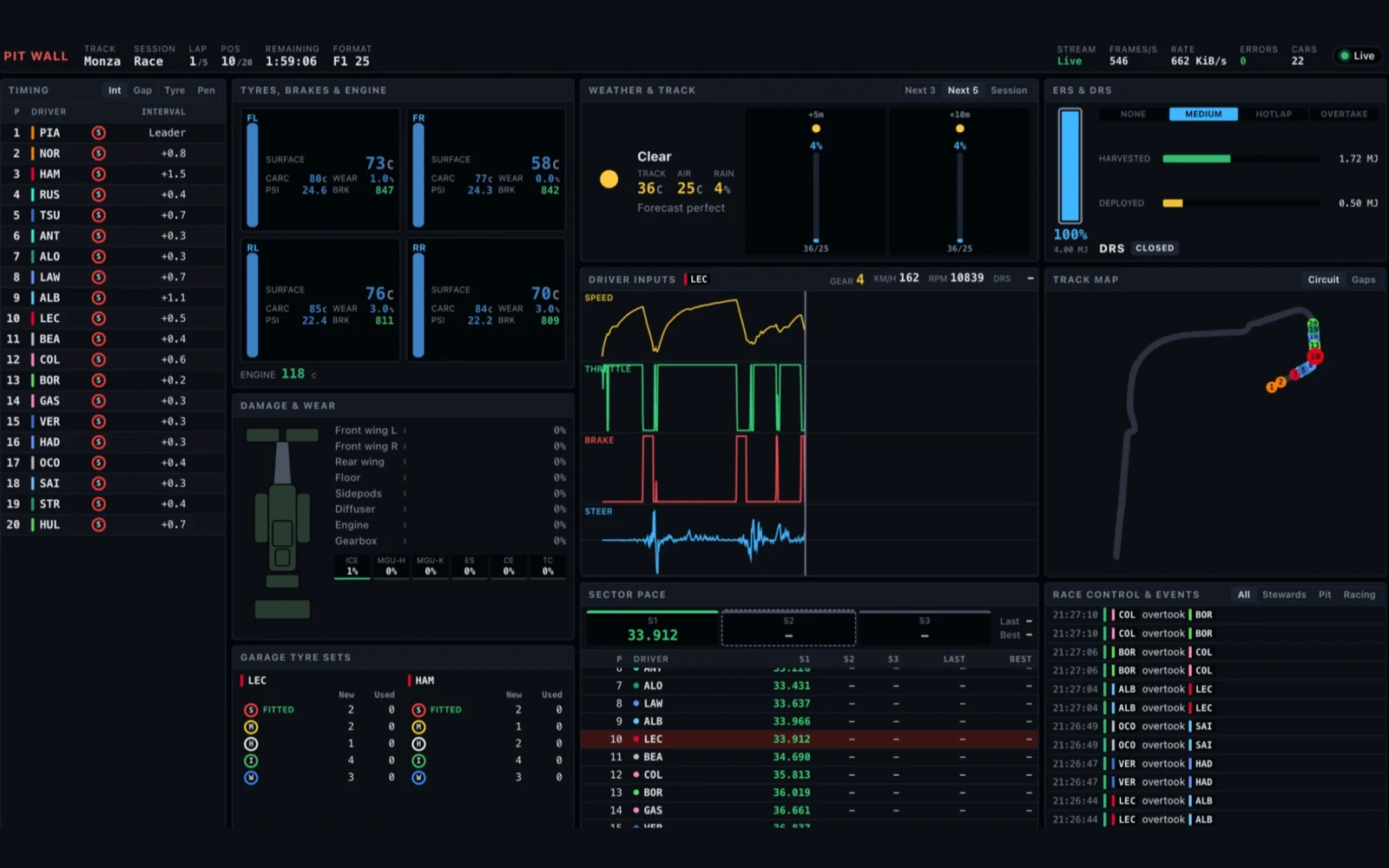
In use, a private tool for my friend and me
F1 Telemetry Platform
Real-time telemetry and a pit-wall dashboard for EA Sports F1 25, tracking up to 22 cars live.
A C++26 edge agent reads the game’s UDP stream and sends only what changed as FlatBuffers. A NestJS hub fans it out over ZeroMQ and WebSockets to a React dashboard that draws the track map at 60 Hz.
Stack
- Python
- Python, FastAPI, Django, DRF, Pytest, asyncio, Playwright
- Data & ML
- Pandas, NumPy, scikit-learn, XGBoost, PyTorch
- AI & LLM
- Model Context Protocol, RAGFlow, n8n, Claude Code
- TypeScript
- TypeScript, React, Redux, NestJS, TypeORM, WebSockets
- Systems
- C++23/26, io_uring, oneTBB, FlatBuffers, ZeroMQ, nanobind, RocksDB, Vulkan, GLSL
- Data stores
- PostgreSQL, InfluxDB
- Infrastructure
- Docker, Kubernetes, AKS, DAPR, CI/CD
Also worked with
Flask, Celery, Redis, Beautiful Soup, Matplotlib, Seaborn, Palantir Foundry, Databricks, Qdrant, React Query, Angular, Tailwind CSS, Sass, Node.js, OpenGL, MongoDB, Supabase, Firebase, Azure DevOps, NGINX, Flutter, Dart, React Native, Tizen, Shaka Player, DASH / HLS / DRM, Lua, Zigbee, Z-Wave, Matter, KNX, Raspberry Pi, Arduino
Off the clock
After hours I do GPU engineering: physics simulations in C++ and Vulkan, with the numerical integration running in GLSL shaders.

Black hole simulator
A real-time GPU renderer for spinning (Kerr) and non-spinning (Schwarzschild) black holes.
Each pixel traces a ray of light backwards through curved spacetime, integrating its path with RK4 in a GPU shader, frame dragging included. The accretion disk gets Doppler beaming and gravitational redshift, which is why one side glows brighter than the other.
d²x/dλ² = −3M |x × v|² x / r⁵
At home I run a Kubernetes cluster, held to the same standards I apply in production:
- Twingate
- Zero-trust remote access
- Infisical
- Secrets management
- Gitea
- Self-hosted Git
- n8n
- Automations and scheduled workflows
- Nextcloud
- Files and sync
- Immich
- Photo library
- Image Vault
- Private Docker registry
- Jellyfin
- Media server
Plus a growing collection of self-written services, built mostly because I could.